6.01.2010

Part Three, the Story of My Garden

I wrote earlier of the giant arborvitae hedge that we removed in the summer of 2007. Today I have a lovely sunny border in its place. We planted some hollies to continue the border that was adjacent to the arborvitae. In front of the hollies, and closer to the back steps I have a small border that blooms primarily in the summer and fall. There isn't much happening in the spring in this border, but I have saved that for another spot in the back yard.


Calamintha nepeta nepeta in the early morning sunbeam. Next to it is a toppled over verbascum 'Southern Charms'. It's very lovely, but it falls over with the slightest provocation.


Against a backdrop of monarda 'Raspberry Wine' are a couple of allium atropurpureum, veronica 'Blue Fox', salvia 'Eveline' to the right. The astilbe 'Amethyst' is taking shape just to the left of the allium.


The sensation cosmos in white sparkles next to the heuchera (I believe it's 'Pretty Polly', but I need to check that). To the right is a catmint.


Here's my favorite vignette of this border so far this year. The gray-tinged purple and green crinkled foliage of the heuchera is set off by the light pink dianthus (slightly overexposed in this image), the strong red dianthus, and the white cosmos. To the right is the sedum 'Matrona', which has a blue undertone that complements the gray cast of the heuchera. In the background you can see the orange zinnia. As the garden matures, the zinnia boosts the gauzy pastels.


The veronica 'Blue Fox' pokes out from the foliage of the heuchera. The scabiosa 'Pink Mist' mingles with the pink dianthus.


Another view of this vignette. A renegade verbascum rises from the scabiosa. It will probably flop over in a day or two, but right now it looks great.


With the neighbors' house in the background, you can see the sunny border from the west to east. Note my 24th anniversary gift from my husband - a new set of garden furniture, which arrived just in time for the Memorial Day weekend.


On the west side of the sunny border, the calamintha mixes with astilbe 'Bridal Veil'. You can just make out the malva on the upper right corner. It started as one plant five years ago, and has re-seeded itself every year since then.


Another view of the east side of the border, with coreoposis 'Moonshine' getting ready to bloom. Next to it is an echinacea 'Rubinstern' and more of the veronica 'Blue Fox'. Baptisia seeds pods are lying next to the echinacea.


A box ball sits next to the lady's mantle. To the right is the aptly named anenome robustissima. I had to place some corrugated metal stripping next to the anenome so it wouldn't overtake an adjacent hibiscus syriacus. Behind the alchemilla is a two year old Calamagrostis 'Overdam'. Next to the grass is a new favorite - echinacea 'Pink Double Delight'.


A view along the sunny border leading to our side yard.


The zinnia really pops out here.


I'm very happy with the contrasts in foliage color and form here.


Many of these flowers float above the foliage. A little cabbage moth has been darting around them for the past few days, brushing by the dainty flowers and making them dance around.


I can't blame the deer here - some birds have been snacking on my sedum 'Matrona'. 


The salvia 'Eveline' has just been planted this spring, so it is still pretty sparse. But some dianthus and sweet alyssum are filling in next to it this year. Next year the salvia will probably take over this spot.
Veronica on the left.


The sun starts to to pour over the border.


Another view of the sunbeam. It highlights the astilbe 'Amethyst' beautifully. The violet astilbe will really pop next to the zinnia once it blooms.


Looking along the border, the structure of the plants is carrying the planting along until the summer color arrives in its full glory.


One last view of the sunny border in the early morning. Regrettably this lovely view terminates in an HVAC condenser unit. The practical realities always seem to get in the way of the ideal, don't they?

Part Two, the Story of My Garden

Just as the composition of the garden was beginning to gel, another fly in the ointment:  we became host to a herd of deer. Suddenly, the lilies, sedum and several other tasty morsels became a veritable salad bar for our local herd. As I stood outside one morning at the top of the back steps and yelled at them, they barely looked up and just kept right on munching.

So out went the Casa Blanca lilies and several other favorites. I did learn that many of my existing perennials, however - the echinaceas, yarrows, astilbes and japanese anenomes - were deer resistant. I soon compiled a list of additional plants that the deer would not, it would be hoped, find too tasty. But I did hang on to my hostas and sedums. No one, not even Bambi, would make me get rid of those.

Here few snap shots of my garden yesterday morning, Memorial Day 2010.


Here's the hosta guacamole, alongside the japanese painted ferns and a bit of ajuga. They are in front of one of the forlorn boxwoods damaged in the winter 2009/2010 blizzards.


Next is the goatsbeard, flopping lazily over the astilbe. This is the astilbe 'Peach Blossom.' It is not as quite as graceful as the others in my garden, but it tolerates dry shade better than the others.


The goatsbeard, astilbe and hosta 'Guacamole', which maintains its fresh green appearance all summer. It will eventually sport incredibly fragrant large white flower spikes.


A view down the shady border. Note the boxwoods tilting permanently to the right!

Hello Again, and Part One of the Story of My Garden

Time, as they say, has a way of slipping away. Today I am re-starting this blog in time for summer adventure and relaxation. What better way to get started than to introduce my garden.

My chapter in this garden has been seven years in the making, although it was started in 1950 by the previous owner. When we moved here in 2003, as only the third owners of a 1940 property, we had the great bones of a well established, but rather overgrown, garden of boxwoods, hollies, and a dozen Tropicana roses.

Did we ever have boxwoods. Probably 200-250 of them all told. Many of them squeezed in places where they could no longer be accessed, or where they had grown over and prevented passage. In other places they were growing in full force of the Washington summer sun, and fading quickly. So we started to purge. And believe me, it's not easy to get rid of boxwoods. The idea was to carefully edit by keeping only selected single boxwoods and nearly all of the curving hedges. We were able to give away several of them. We also managed to relocate many of them. And in one heartbreaking instance, a small hedge of them, which I had relocated only four months earlier, were decimated in a split second one January day by a falling avalanche of snow from the sunroom roof. It was horticide of the first order.

We suffered further disappointment this past winter, following the now-famous Snowpocalypse and Snowmaggedeon blizzards.


It certainly did look beautiful under the blue winter sky.


Here's the proud snow shoveler standing in front of his piece de resistence. This completely blocked off access to our back yard for about a month. On the right you can see one of the American boxwoods bent over into the driveway.

All of the boxwoods in the back yard, both English and American, bent over  under the weight of the heavy wet snow for about three weeks. Usually our heavy snows melt away in a matter of a few days. These back to back storms kept the shrubs doubled over for nearly a month. Although we didn't lose any of them outright, they did suffer tremendous disfigurement. The hedges in the front yard fared much better, for some reason.

There were also several yews that tightly girdled the front and back entrances. As much as I like yews, these again were completely misplaced. But digging these out, as anyone who has dared can tell you, is difficult because of the deep and stubborn tap roots. After digging deeper and deeper without disturbing the tap root, he finally climbed down into the hole attacked it with the masonry saw. That did it!

The poor old Tropicanas died away, one by one. I tried for three years to keep them going. But the back yard had become so shady since they had been planted years earlier, that they barely bloomed. I also tired very quickly of the spraying and coaxing that still resulted in black spot and stunted blooms. So out they went.


A beautiful flower that fades from salmon to soft pink. But I was no match for the black spot and mildew.

The most dramatic change involved removal of a 30 foot long, 30 foot high arborvitae hedge close to the house. Not only did the Green Monster bathe the east side of our back yard in shade, it was rapidly growing out of control. Time for that baby to go:  I spent an entire paycheck on having it removed, just as it was threatening to walk in the back door. Suddenly I had a whole new section of garden to merge into the existing plantings.

It was time to rethink the entire plan. With my interest in perennial gardening in a more natural style, I started to divide the garden into different zones. I obsessively observed the sun traveling over the yard from morning to night during all the seasons of the year. I noted the consistently sunny, partly sunny, and pretty much always shady spots. I also noted the dry spots (e.g., under the neighbors' 70-foot holly tree) and the wet spots. Over successive summers I tried (and often failed) with a variety of perennials, biennials and a few annuals to fill in. I tried different color combinations, heights, foliage colors and textures. And often I found plants that either got too comfortable with their accommodations, or those that could barely grow before they fell over. I dug new beds, made them bigger, and then made them bigger again. I added bags and bags of compost. My effort has finally started to pay off.

I feel that I am now very close to settling on a plan and a selection of hardy plants that more or less can survive our sultry, humid summers, wild springs and unpredictable winters.

Next, Part Two of the story of my garden.

9.22.2009

It's beginning to smell a lot like Christmas - on Labor Day

So, here we were, the first weekend in September, empty nesters for the first time. We had the whole weekend before us, and what did we do?

How about canning 50 pounds of peaches?


Well, many years ago we had our tomato sauce summer, when the kids were very young. We also had our Chocolate Fruit Cake Christmas when we were first married. So mass quantities of preserved food, for us, is kind of romantic, not to mention nostalgic.

OK, so we ate a few peaches out of the box, made a peach pie, and also four jars of peach chutney. But still, here we were with two crates of peaches, one from New Jersey and one from Venezuela.


It all started with a New York Times Magazine article on canning brandied peaches last month. Why, we thought, wouldn't this make a fantastic Christmas gift idea? Lots of ripe peaches, first rate brandy, and snappy jars! What could be better?


Figuring out the assemblage of pots on our four burners was the trickiest part. It involved closely choreographed kitchen ballet, moving the pots and pans back and forth as each step was completed.

(Also, I burned a finger halfway through the evening and had to keep ice on it the rest of the time. Remember that when you're enjoying your peaches, if you are a lucky recipient this Christmas.)

The entire kitchen smelled great, and became very, very sticky. I am still finding sugar on the cabinet door handles. Also, I think we went through 18 dish towels.


The hinged lid Italian jars (above and below) are very attractive, but they're very awkward to use. The two-part Leifheit jars were almost as attractive, and much easier to fit in the big stock pot.


The first night we canned the crate of white peaches. By the end of the evening, we were getting pretty fast!


Just for the record, the brandy was quite good.


Four hours later, and only one crate processed. So we saved the yellow peaches for Tuesday night (besides, they weren't quite ripe yet).


In the end, I am happy to report that we also had to use my extensive collection of Bonne Maman jelly jars, lovingly collected for many years. I knew they would come in handy one day! (That single purple jar lid was, I think, from a jar of boysenberry jam from last summer. Probably some kind of seasonal, limited edition thing.) All told, we preserved 46 jars of brandied peaches and four jars of chutney!


Of course, we just had to try a jar ourselves.

8.30.2009

My Favorite Room


I may as well make it very clear early on in this venture that my favorite room in a house is a library. Notice that I say "a house," and not, "my house," because I don't have a library. Not yet, anyway. But in the meantime I can dream about a classic English library.


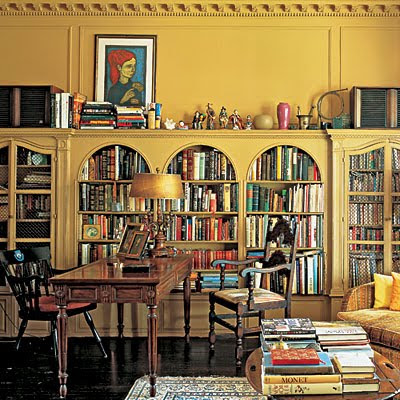
The image, above, is a good example. Note the floor to ceiling built-in shelves with discreet lighting fixed to light the books. The shelves are deliberately, but not too perfectly arranged, with some titles lying on their sides (these were probably too tall otherwise). A few well-chosen objets are mixed in to break up the monotony of rows of books. A leather chair is practically a requirement for a classic library, preferably worn and slightly beaten. Finally, strong colors should predominate in my fantasy library. This doesn't mean dark, gloomy, tobacco stained walls and the crepuscular glow of oil lamps. As shown above, a library can still benefit from a fair amount of natural light.


The deep mustard color of these shelves makes my mouth water! Note that these shelves don't reach the ceiling. Instead, molding details and a very pretty scalloped crown continue above. The resulting bookshelf top has allowed the owners to display a jumbled collection - and not surprisingly, more books - including a pretty portrait with blue and red that contrasts beautifully with the yellow woodwork. I also like the way these shelves start about a foot from the ground. These shelves are easy to reach, and therefore must be very easy to use. Note also the arches, which break up the horizontal lines, and the chicken-wire screens used on pairs of arched doors. I could easily meditate in this room for hours, without even picking up a book.

Other essential ingredients for my library: A variety of quirky Edwardian upholstered furniture (see my post on loveseats for some examples), plenty of good reading lights at each chair and sofa, small tables dotted around for drinks and my laptop, a well worn oriental rug, a few simple flowers (not too fancy, or if they are then just one or two sitting in a small vase or cup), a couple of antique occasional chairs, at least a little bit of velvet or embroidery in the textiles. And lots of art work, in different styles, sizes and heights on every wall, with appropriate picture lighting, and perhaps even hanging from some of the shelves themselves.

It should all be organized, but still haphazard. Does that even make sense?

What I don't like: Heavy drawing room curtains. These would just feel too oppressive. Not to mention they would be gigantic and expensive dust, pollen and odor collectors. Simple straight panels to keep the room balanced and keep out the drafts, combined with shades if necessary, are fine, thank you.

In At Home with Books: How Book Lovers Live with and Care for Their Libraries, authors Estelle Ellis and Caroline Seebohm and photographer Christopher Simon Sykes capture many examples of real-life libraries that inspire my fantasy. As to why I and others find these rooms so captivating, the authors write in their introduction:

Book-centered rooms are described as nurturing, a comfort zone, an
escape hatch, a place to retreat to for tea and talk, thinking and
reading, recapturing memories, regenerating spirit and ideas.

Some other inspirational titles: The English Room, by Chippy Irvine and photos also by Mr. Sykes; Perfect English, by Ros Byam Shaw; and Domestic Art: Curated Interiors by Holly Moore, Rob Brinkley, and Laurann Claridge. There are lots of other great examples; these are just a few of my favorites.

I'll leave you with a few more images. These are updated, lighter versions that would work well in the average home. The first two are from Domino:


8.25.2009

Seasonal Walk

For me, no trip to New York would be complete without a visit to the New York Botanical Garden. It is so easy to get to by subway or car, that there is no excuse not to visit this beautiful refuge in the Bronx.

Right now, my idea of Paradise would be to live in this garden, the Seasonal Walk, created by two of the most talented garden designers now in practice, Piet Oudolf and Jacqueline van der Kloet. These Dutch designers are first and foremost plant-centric. They both build on a solid foundation of design, but their priority is the plants. Piet is a well-known proponent of perennials in the Dutch "new wave" movement; Jacqueline is the bulb specialist. Their program was to create a four-season border alongside the NYBG's Enid A. Haupt Conservatory. Imagine having two huge borders - one 186 feet and the other 86 feet long - to plan, plant, and nurture!
The project has been so successful that the NYBG has extended the show for an additional year, through 2010. Even if you won't be able to enjoy the garden in person, the Seasonal Walk Chronicles are well worth repeated visits online. Garden writer Tovah Martin and photographer Rob Cardillo have created a terrific diary of the garden's development. It's a must-read for any of us interested in learning the secrets of the Dutch dynamic duo who have previously collaborated on two projects, both in the US: Battery Park in New York and the Millennium Park in Chicago.
I can't wait to visit this special place again; perhaps this fall. Stay tuned! I hope to bring you some of my own photos of the Seasonal Walk myself.
In the meantime, here is a sample of beautiful photos taken by my very talented son Peter during our trip to the NYBG two summers ago.


All photos copyright 2009 by Peter M. Mueller.

8.15.2009

Dark Mantel

There has to be some sort of compensation for putting up with Washington-area traffic, cost of living, and humidity.

Indeed there is, for any time you have a few hours you can head down to the National Gallery of Art. It is simply one of the finest museum experiences you are liable to find anywhere, just for the sheer beauty of the buildings, if not the magnificent art. This is exactly what we did last weekend.

We are trying to enjoy the last days of summer before we pack off our younger child to college. He, being an eager photographer, suggested the trip. And the first gallery we visited was the Small French Paintings, located in the East Building's lower level.

Donated by Ailsa Mellon Bruce, this collection is one of our family's favorites.

The painting that really caught my eye on this visit is Edouard Vuillard's Vase of Flowers on a Mantelpiece, c. 1900.


What a fantastic idea! I started picturing our mantel painted black. Now that would really pull together the new seating arrangement, giving our modest living room an undeniable focal point. It would also give a bit of edge to a room filled with furniture that is either painted off-white or just medium brown wood. And what about that bit of greeny blue in the mirror's reflection? I've been thinking of using that as the fabric color for the eventual new loveseat. I also love the touch of green on the crown molding. This echos the green of our adjacent dining room.

Although it has a late Victorian look to it, the painting and the room have a distinctly lighter French feel.

The only question is, would the mantel look best in a glossy or eggshell finish?

Vuillard liked to include at least one prominent dark object in many of his works. Here's a pastel entitled Madame Josse Hessel in Vuillard's Studio from 1915.


Many of the same colors are used in this painting. There's the overall softness of the pinky beige walls and blue door sharpened by the dark seated figure on the left and the artist's shelves on the right. And again a touch of green through the doorway and above the shelves.

I think I see a pattern developing here for my ongoing pursuit of living room decoration.

Vase of Flowers courtesy of the National Gallery of Art; Madame Hessel courtesy of The Athenaeum.